We are excited to announce OpenVM 2.0.0, the first production release of OpenVM 2.0. With this release, OpenVM 2.0 has completed an external security audit by zkSecurity and is now recommended for production use. We have also expanded our formal verification coverage to include the Keccak and SHA-2 extensions in addition to the previously verified RV32IM.
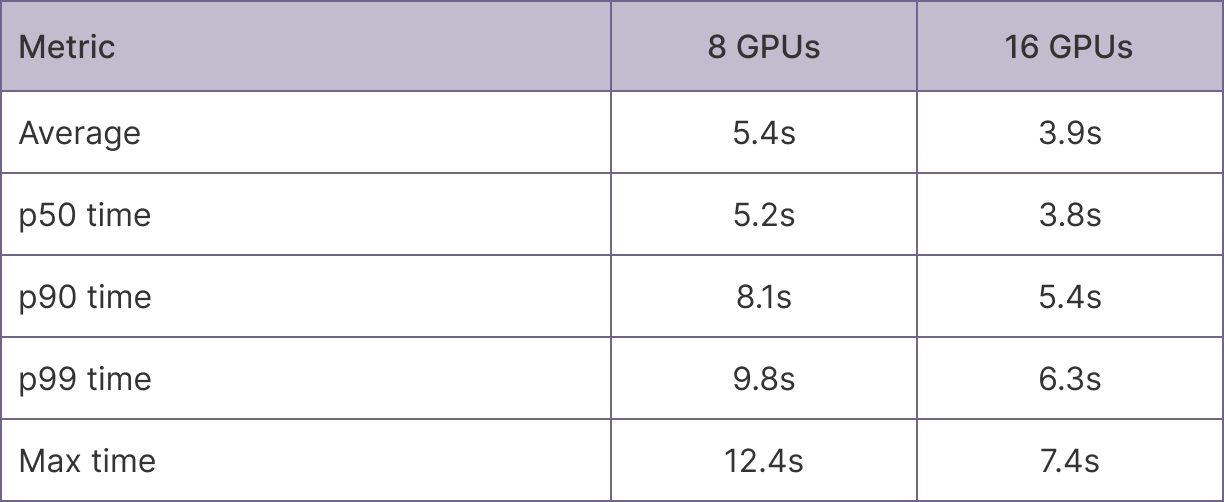
The production release introduces deferrals, a new feature that lets OpenVM guest programs verify arbitrary ZK circuits, and also adds GPU proving for Halo2, enabling faster proof generation for EVM verification. On the performance side, OpenVM 2.0 improves upon the performance of the beta release from April. OpenVM now proves mainnet Ethereum blocks in real time on 8 5090 GPUs, with a p99 time of 9.8s on 8 GPUs and 6.3s on 16 GPUs. It maintains 100 bits of provable post-quantum security and proof sizes under 300kB.
OpenVM 2.0 is available open-source under the MIT and Apache 2.0 licenses on GitHub, including the GPU prover. To learn more, check out the developer docs or follow us on X.
What’s New
This production release introduces deferrals, a new feature that enables the verification of arbitrary ZK circuits in OpenVM guest programs. Proofs from custom specialized circuits can now be composed with general-purpose computations inside a single OpenVM proof, which opens up a variety of new use cases for developers, including:
Proof aggregation for rollups: Rollup execution is typically proven in chunks of blocks, and deferrals let a single OpenVM program verify those chunk proofs and produce a single proof for final on-chain verification. This enables more flexible and cost-efficient proof aggregation pipelines for ZK rollups.
Verified AI inference: Deferrals also open up future applications such as verified AI inference, enabling model inference to be proven in a custom circuit for efficiency, and then composed with general OpenVM programs for general business logic like input preparation and output post-processing. This gives developers the efficiency of a specialized circuit with the ease of use of a zkVM.
Deferrals generalize to any workflow combining specialized circuits with general computation. In this initial implementation, their latency overhead starts at 1s for a single proof and drops to as low as 300ms for 32 proofs.
OpenVM 2.0 also now ships with a GPU prover for Halo2. This enables SNARK wrapping of OpenVM proofs in 8.1s on a single 5090 GPU, giving developers the ability to verify the resulting proofs on any EVM chain with relatively low overhead. We expect to improve rapidly on this initial performance in future releases.
Security Assurance
OpenVM 2.0 has completed an external security audit by zkSecurity (report available here) covering our implementation of the SWIRL proof system, the aggregation and continuations circuits, deferrals and the Halo2 verifier, and updates to the OpenVM SHA-2 and Keccak extensions. With this extensive security work, OpenVM 2.0.0 is now recommended for production use.
As an additional security effort, the updated OpenVM Keccak and SHA-2 extensions are now formally verified alongside the previous verification of the RISC-V extension, significantly expanding our formal verification coverage. Formal verification efforts are continuing across the broader OpenVM system, and we hope to share more details in an upcoming release.
Performance Updates
This production release of OpenVM 2.0 further improves upon OpenVM 2.0 Beta’s performance. For performance evaluation, we measured end-to-end proving time of STARK proofs on Ethereum mainnet blocks. Benchmarks were run on bare-metal clusters of 5090 GPUs with 100 bits of provable security and proof sizes under 300kB.
On a stretch of 7200 Ethereum mainnet blocks starting from block 24,000,000, OpenVM 2.0 achieves a p99 proving time of 6.3s, an average of 3.9s, and a max of 7.4s on 16 5090 GPUs, a 15-20% improvement over OpenVM 2.0 Beta.
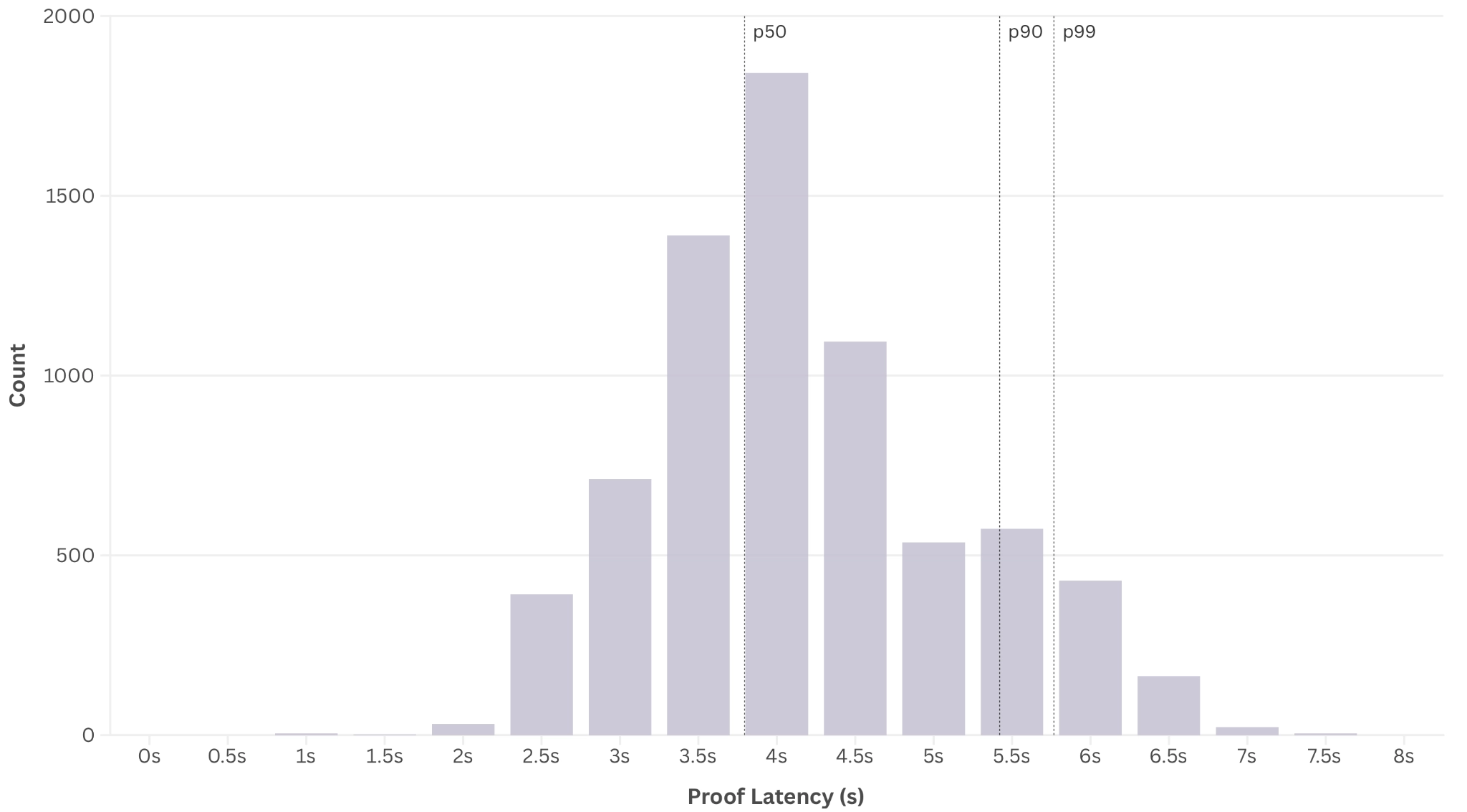
On a smaller cluster of only 8 5090 GPUs, OpenVM 2.0 now proves Ethereum in real time, with an average proving time of 5.4s and a p99 time of 9.8s. By reducing the hardware requirements for Ethereum proving, we drive toward greater decentralization and scalability for the chain.
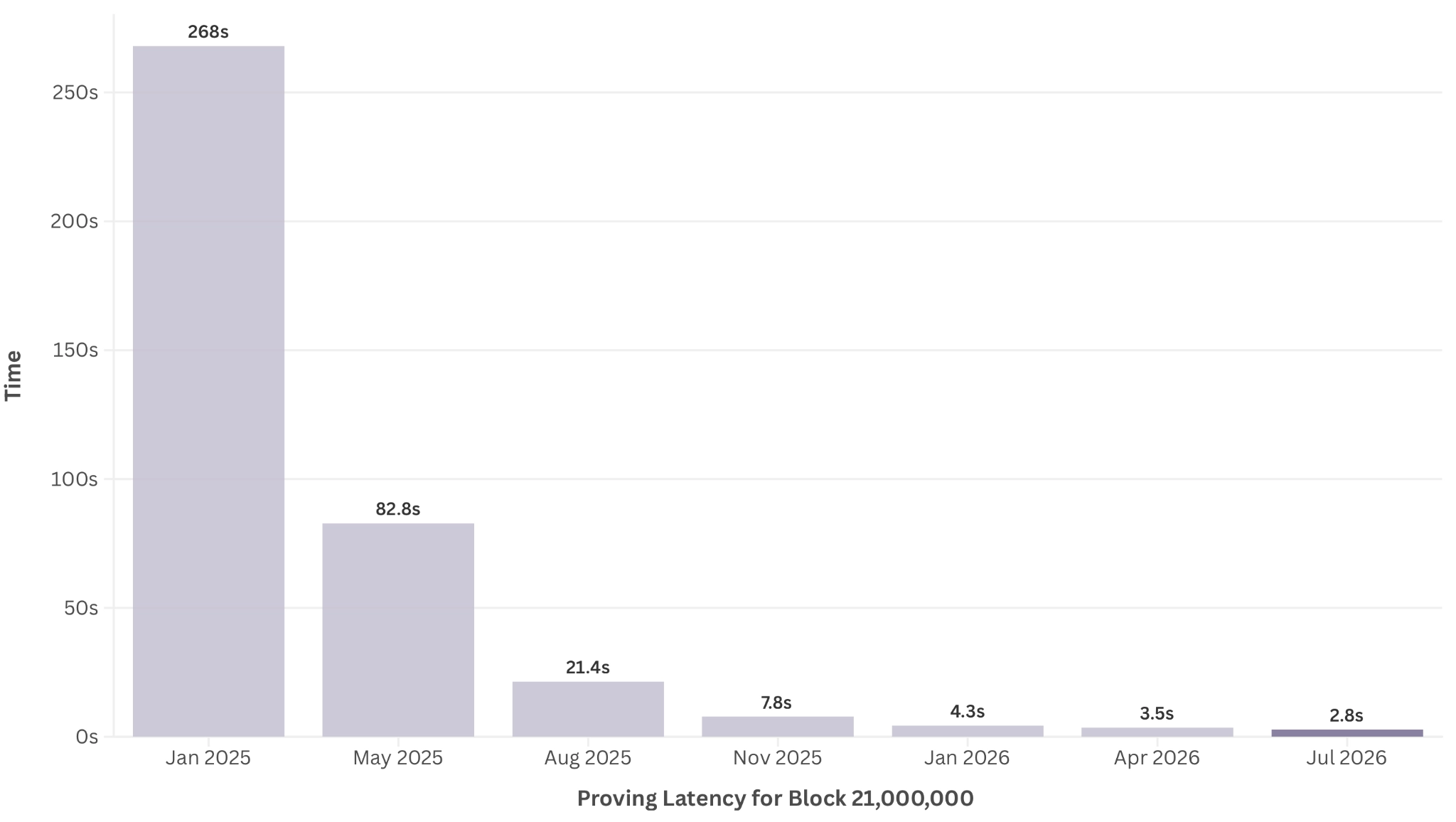
For mainnet block 21,000,000, OpenVM 2.0 shows continued performance velocity by reducing proving time to 2.8s, a 95x improvement in the 18 months since our original v0.1 release.
Try OpenVM Today
OpenVM 2.0 is now available under the MIT and Apache 2.0 licenses and is recommended for production use. To try it out, check out the developer docs and the full release on GitHub. We are excited for the new types of infrastructure and applications that OpenVM 2.0's cutting-edge performance and robust security will enable.