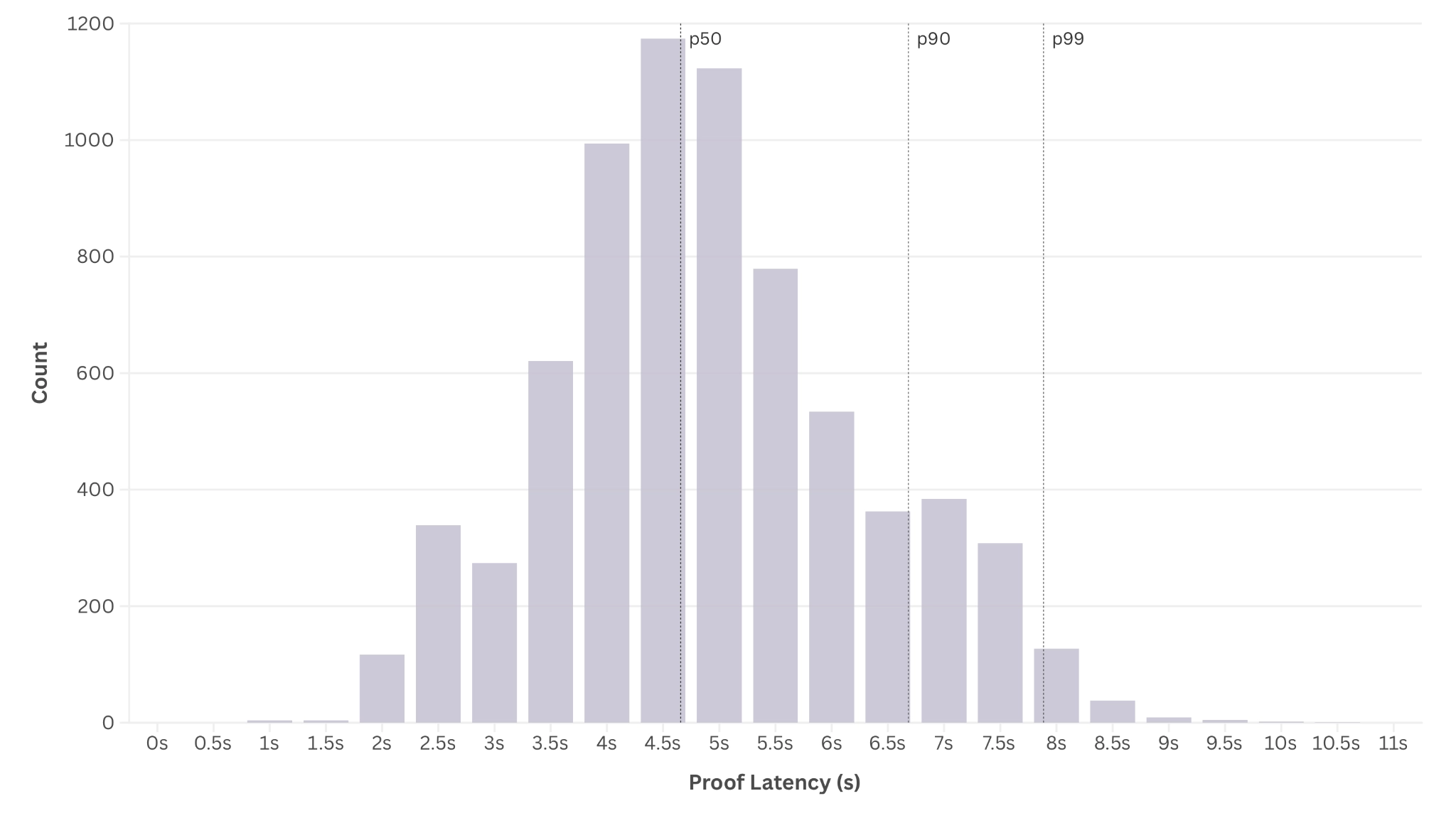
We are excited to release OpenVM 2.0 Beta, featuring substantial performance gains over the initial OpenVM 2.0 Alpha release in January. OpenVM 2.0 Beta proves mainnet Ethereum blocks in a p99 time of 7.9s on 16 5090 GPUs, has 964 MHz RISC-V throughput on 64 5090 GPUs, and maintains 100 bits of provable post-quantum security and proof size under 300 kB.
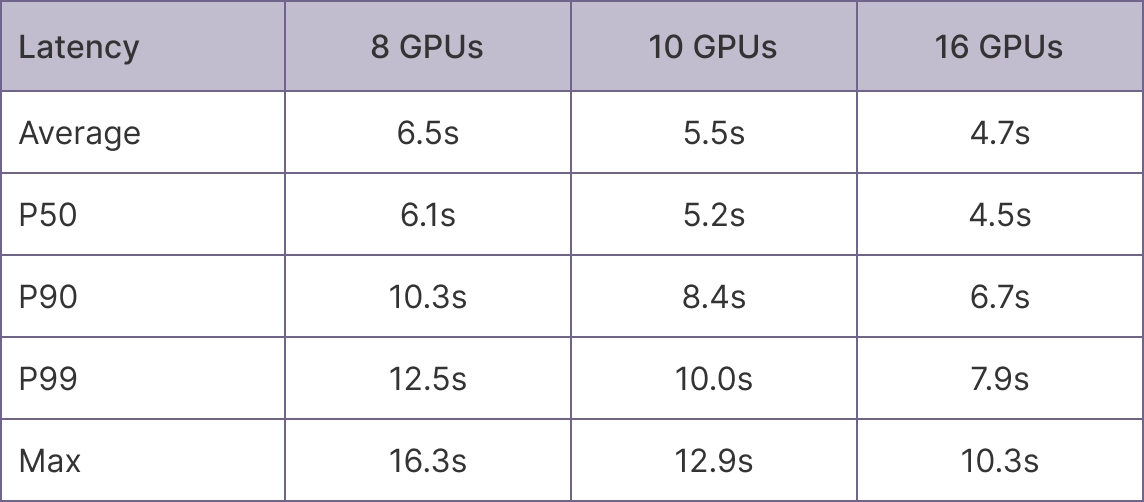
With these performance improvements, OpenVM 2.0 can prove Ethereum in real time on a cluster of only 10 GPUs with a p99 time of 10.0s. We expect continued performance gains to facilitate Ethereum’s decentralization and enable more ZK use cases as we make real-time proving accessible through our virtualized processor.
OpenVM 2.0 Beta is open-source under MIT and Apache 2.0 dual license on GitHub, including the GPU prover. We’ve also added the ability to verify OpenVM 2.0 proofs on any EVM chain for 316K gas via a Halo2-based recursive proof. Lastly, the updated SWIRL whitepaper now incorporates the list-decoding regime for optimized recursion performance. To learn more, check out the preview docs or come chat with us at the developer Telegram.
Performance Benchmarks
OpenVM 2.0 Beta substantially improves upon the OpenVM 2.0 Alpha release from January 2026. To evaluate performance, we measured end-to-end proving time of STARK proofs for Ethereum mainnet blocks as well as some common benchmark workloads for embedded processors. Benchmarks were run on bare metal clusters of 5090 GPUs with 100 bits of provable security and proof sizes under 300 kB.
On a recent stretch of 7200 Ethereum mainnet blocks starting from block 24,000,000, OpenVM 2.0 Beta achieves a p99 proving time of 7.9s, an average of 4.7s, and a max of 10.3s on 16 5090 GPUs — significantly improving upon OpenVM 2.0 Alpha's p99 time of 11.8s. This definitively passes the performance targets set by the Ethereum Foundation for proving Ethereum L1 in real time. In conjunction with this release, we are also demonstrating this performance live on EthProofs.
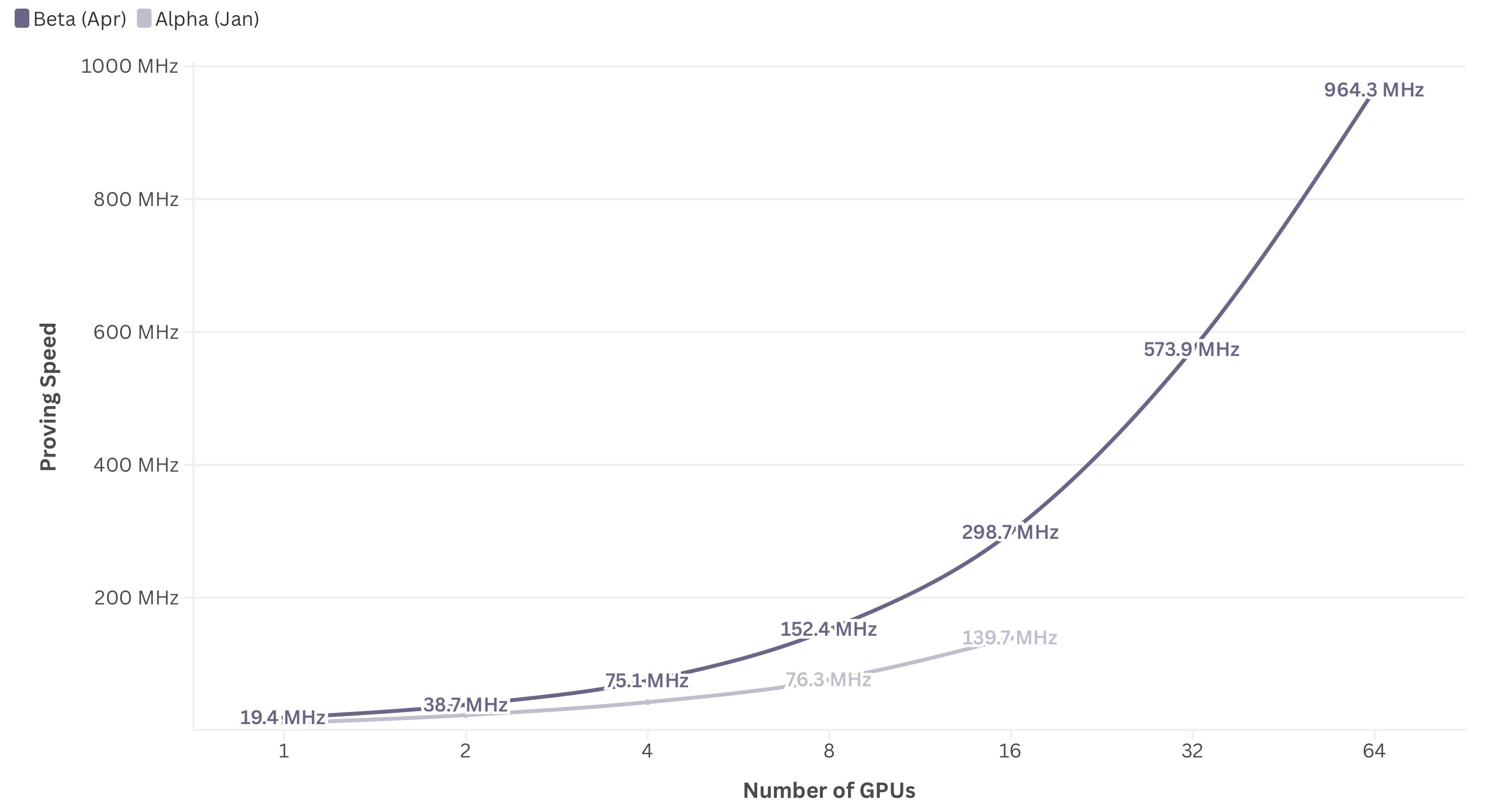
On an adaptation of the industry-standard CoreMark benchmark for embedded CPUs to RV32IM, OpenVM 2.0 Beta proves at 19.4 MHz on a single 5090 GPU and now scales up to 964 MHz on a cluster of 64 GPUs, representing a roughly 2x performance improvement over the OpenVM 2.0 Alpha release in January.
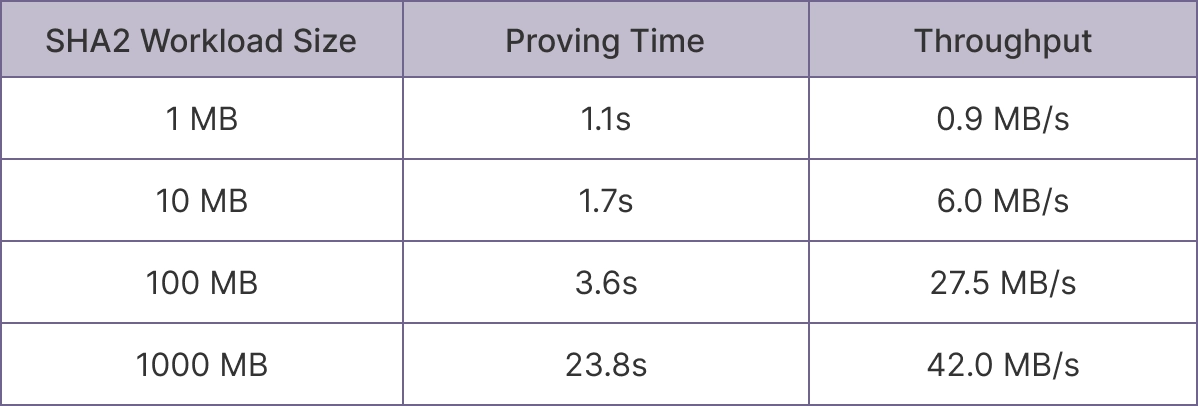
OpenVM 2.0 Beta is also able to prove SHA2 hashes at 42MB/s on a cluster of 16 5090 GPUs, about 50x slower than the best native single-core performance.
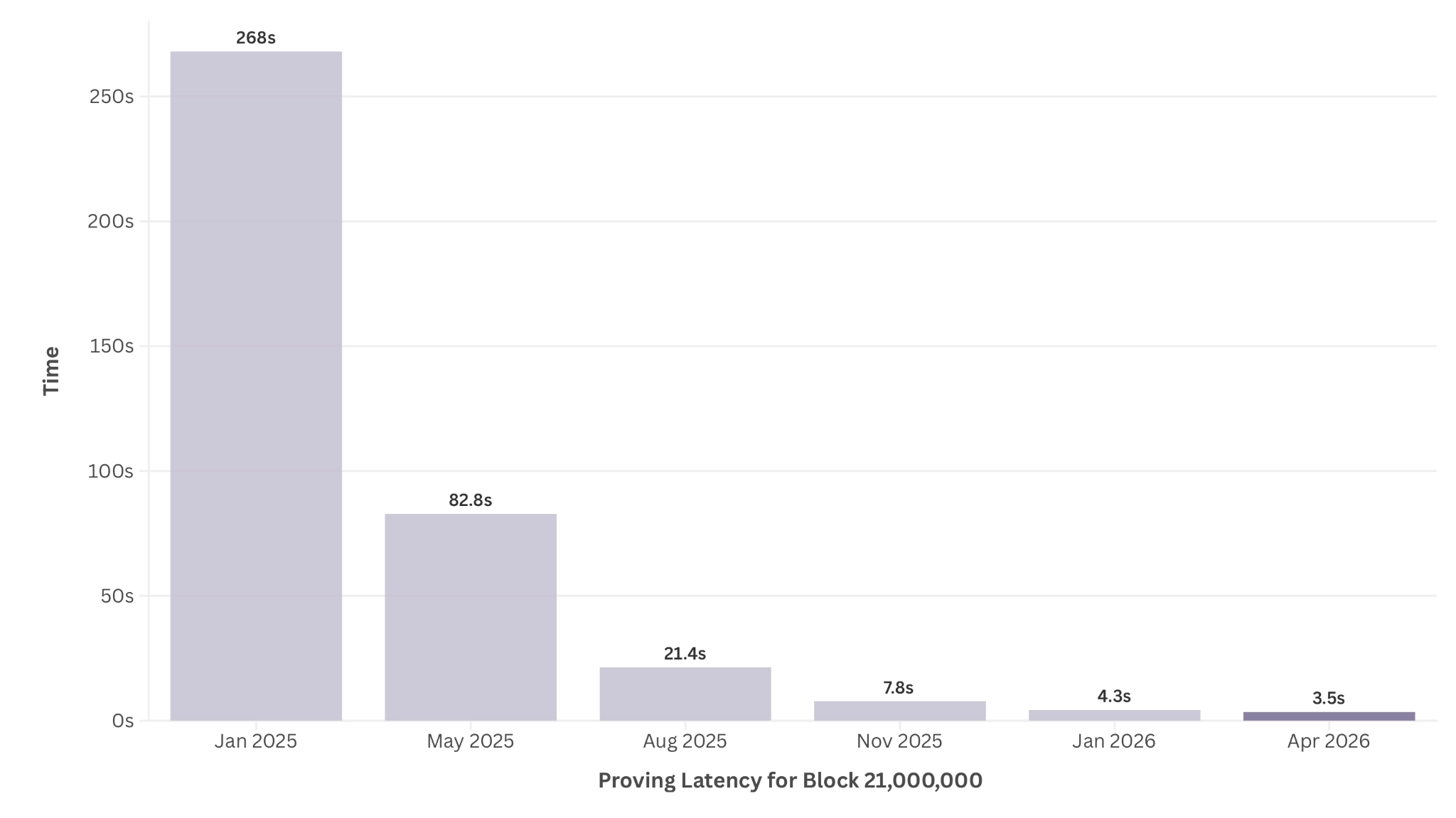
On mainnet block 21,000,000, OpenVM 2.0 Beta shows continued velocity in performance improvement, reducing proving time to 3.5s and at a 25% month-over-month rate throughout the 15 months since the v0.1 release of OpenVM.
Diving into Real-Time Ethereum Performance
To better analyze performance of OpenVM 2.0 Beta for proving Ethereum L1, we evaluated proving latency on clusters of 8, 10 and 16 GPUs. OpenVM 2.0 is now able to prove Ethereum in real time with a p99 latency of 10.0s using only 10 GPUs, and we expect further improvements as we continue to push on OpenVM performance.
To study the effect of workload on proving latency, we plotted latency on 16 GPUs against gas usage for the same range of 7200 mainnet blocks starting at block 24,000,000. We found that proving time was roughly linear in gas usage with minimal outliers, an encouraging initial result for the robustness of using ZK verification for Ethereum scaling.
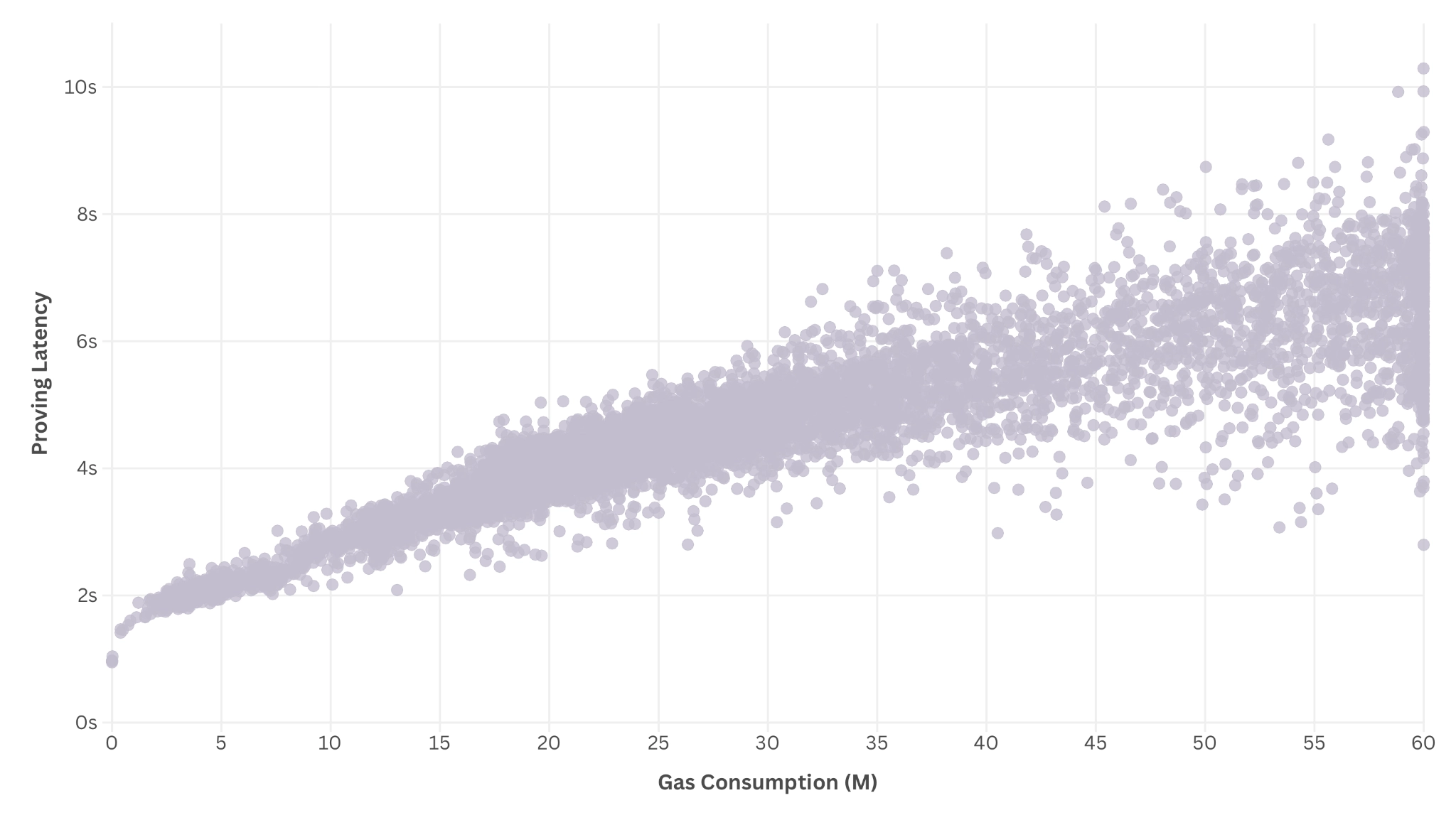
Finally, we manually analyzed the top 10 blocks by proving time in this block range to identify causes of outliers. We found the slowest blocks to prove either had heavy usage of the MODEXP precompile or heavy usage of CALL / DELEGATECALL for XEN batch mints. A few representative blocks are:
Block 24001988 [10.3s proving time]: Four batch mints for the XEN token take 51.9M gas, with 1601 CALL and DELEGATECALL opcode invocations leading to heavy proving cost for account and storage proofs.
Block 24002549 [9.9s proving time]: In addition to some XEN batch mints, this block has an Aztec Ignition rollup proof verification, which uses 277 MODEXP, 65 ECADD, and 65 ECMUL precompile calls.
Pathway to Production
OpenVM 2.0 Beta is now available under MIT and Apache 2.0 dual-license in pre-production preview. To try it out, check out the preview docs and the full release on GitHub. We are excited for the new types of infrastructure and applications this will enable.
We are working towards a production release of OpenVM 2.0 in the coming months after the completion of external security reviews. In the meantime, to stay updated or get involved, join us on Telegram or X.